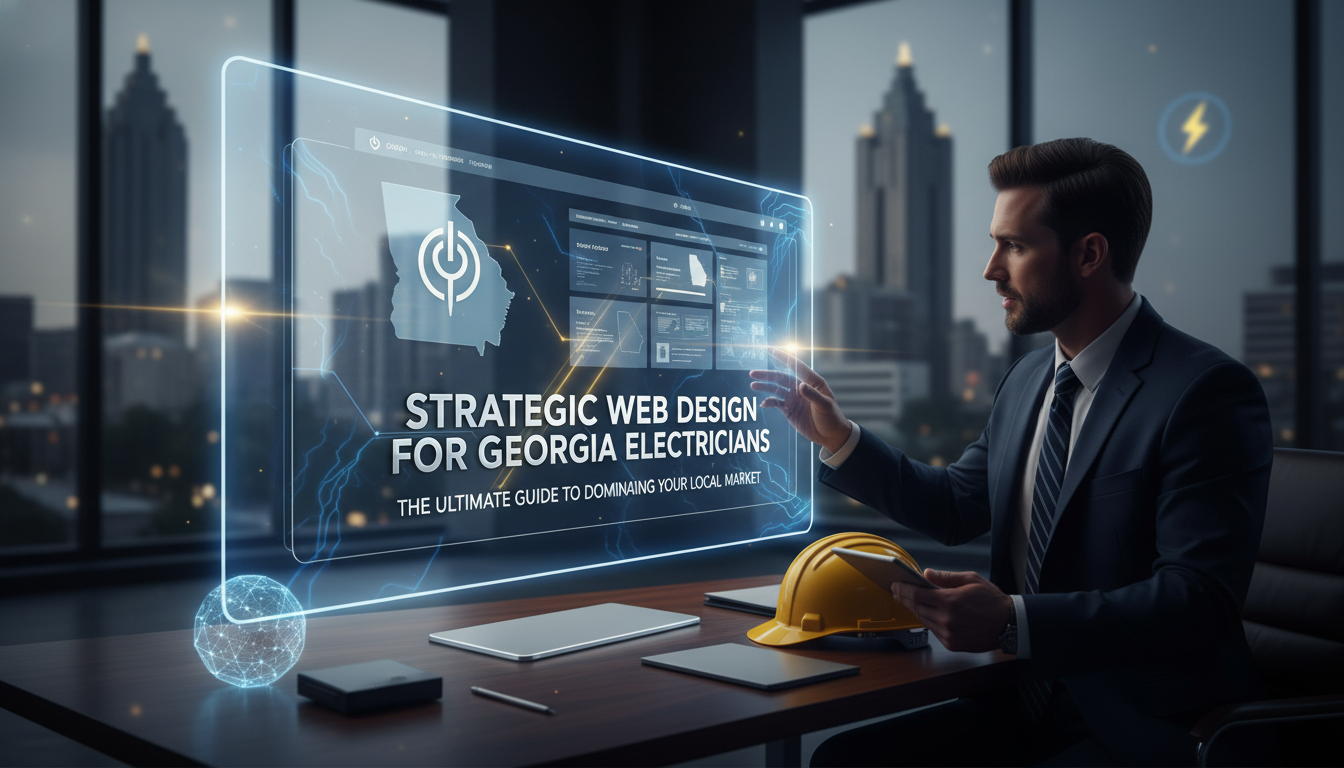
Strategic Web Design for Georgia Electricians:
The Ultimate Guide to Dominating Your Local Market
In the rapidly growing Georgia market, traditional word-of-mouth is no longer enough. Discover how an elite, high-performance web design strategy can transform your electrical contracting business into a dominant local authority.
The Digital Shift in Georgia’s Electrical Industry
From the bustling commercial hubs of Atlanta and Alpharetta to the historic residential districts of Savannah and Augusta, the demand for licensed electricians in Georgia has reached unprecedented heights. The state is experiencing a massive influx of new residents, extensive commercial development, and an accelerating transition toward smart home automation and EV (Electric Vehicle) infrastructure. However, despite this booming demand, many local electrical contractors are leaving millions of dollars on the table due to underperforming, outdated, or invisible web assets.
In 2026, when a homeowner experiences a late-night power outage, or a facility manager needs emergency commercial wiring, they do not consult the yellow pages. They pull out their smartphone and search for immediate, trustworthy solutions. If your website takes more than three seconds to load, lacks clear conversion pathways, or fails to project immediate authority, that prospect will instantly bounce to your competitor. This is where strategic web design transitions from a luxury to a critical operational necessity.
To truly capture market share, an electrician’s website must act as a 24/7 autonomous sales machine. It must seamlessly blend elite aesthetics with psychological conversion triggers, fast load times, and localized search dominance. By leveraging comprehensive Digital Marketing Services, electrical contractors can engineer digital footprints that outrank local competitors and attract premium, high-margin projects.
Core Elements of High-Converting Electrician Website Design
Mobile-First Emergency Architecture
Over 70% of local service searches occur on mobile devices. For electricians, this metric is often higher due to the emergent nature of the work. A homeowner standing in a dark room with a blown breaker panel needs your site to load instantly. Strategic web design ensures that your click-to-call button is persistently visible, navigation is frictionless, and emergency services are highlighted front and center. Speed is not just a ranking factor; it is a critical trust signal.
Trust & Authority Signals
Electrical work inherently involves high risk and stringent safety codes. Your website must instantly alleviate consumer anxiety. This is achieved by prominently displaying Georgia state licenses, insurance credentials, BBB ratings, and real customer testimonials. Incorporating high-quality images of your branded trucks and uniformed technicians builds subconscious trust before the prospect even makes the call.
Local Search Dominance: Owning Your Georgia Territory
A visually stunning website is completely useless if no one can find it. For Georgia electricians, hyper-local visibility is the cornerstone of lead generation. This requires a granular approach to technical site structure. Each of your core services—such as panel upgrades, lighting installations, EV charger setups, and smart home integration—must have its own dedicated, highly optimized page. Furthermore, creating specific service area pages for cities like Marietta, Roswell, Macon, and Columbus allows you to cast a wider, yet highly targeted, net.
Effective local visibility goes beyond basic keywords; it involves sophisticated schema markup, Google Business Profile API integrations, and continuous technical optimizations. To dominate search engines and secure the coveted top three spots in the local map pack, contractors must invest in professional SEO & Organic Search Engineering. This scientific approach ensures that when a prospect types ‘best electrician near me’ or ‘commercial electrical contractor Atlanta’, your brand is positioned as the definitive choice.
Scaling Up: Capturing Commercial and B2B Contracts
While residential service calls provide steady cash flow, commercial electrical contracts—such as retail build-outs, warehouse wiring, and facility maintenance agreements—drive exponential revenue growth. However, commercial decision-makers (general contractors, property managers, and facility directors) evaluate your business differently than homeowners. They look for capacity, compliance, bonding capabilities, and proven project management expertise.
Your strategic web design must feature a dedicated commercial hub that speaks directly to these B2B pain points. Case studies highlighting complex installations, detailed safety protocols, and commercial project portfolios are non-negotiable. To actively pursue and acquire these high-value commercial clients, forward-thinking Georgia electricians are utilizing Account-Based Marketing (ABM) & B2B Growth strategies. This allows you to specifically target key developers and property management firms across the state with hyper-personalized digital experiences.
Fueling Growth with Content Velocity
In the modern digital landscape, content is the engine of authority. A static website eventually stagnates in search rankings. To continuously signal relevance to search engines and value to potential customers, Georgia electricians must deploy a robust content strategy. This means publishing comprehensive guides on electrical safety in older Southern homes, the ROI of LED retrofitting for commercial spaces, or the requirements for residential EV charger installations.
High-quality, localized content not only captures long-tail search traffic but also positions your brand as an educational leader in your community. By partnering with experts in Creative Strategy & Content Velocity, electrical businesses can consistently output authoritative articles, video content, and infographics that engage audiences and drive aggressive organic growth.
Expanding Your Reach Beyond State Lines
As your electrical contracting business dominates the Georgia market, the next logical step is regional expansion into neighboring states like South Carolina, Florida, or Tennessee. Expanding your digital footprint across state lines introduces complex challenges, including multi-location site architecture, regional search intent variations, and localized compliance messaging.
Managing a multi-state digital presence requires a highly scalable web foundation. Your site architecture must effortlessly accommodate new location hubs without diluting your core domain authority. For ambitious contractors looking to conquer the Southeast, engaging in a Global Growth & Localization Strategy ensures that your brand translates effectively into new territories, capturing market share with localized precision and enterprise-grade infrastructure.
Deep-Dive FAQs on Georgia Electrician Web Design
1. How long does it take to design a custom website for an electrician in Georgia?
A high-performance, custom-designed website typically takes between 6 to 12 weeks to complete. This timeline includes deep market research, custom UI/UX design, mobile optimization, technical SEO foundation building, and rigorous speed testing to ensure it outranks local competitors in cities like Atlanta or Savannah.
2. What specific features are absolutely essential for an electrical contractor’s website?
Essential features include a persistent click-to-call button for mobile users, dedicated service pages (e.g., EV charging, panel upgrades), localized service area pages, high-visibility trust badges (licensing, insurance, BBB), an integrated online booking or emergency contact system, and fast-loading image galleries of completed projects.
3. How does local SEO differ for electricians compared to other trades?
Electricians face uniquely high emergency search volume. Local SEO for electricians must prioritize speed and mobile indexing heavily, while optimizing for high-intent, immediate keywords like ’emergency electrician near me’ or ‘power outage repair’. Additionally, safety and licensing schema markups are critical for Google’s trust evaluation.
4. Should I display my electrical service pricing directly on the website?
While exact quotes are difficult due to the variable nature of electrical work, displaying ‘starting at’ prices or flat-rate diagnostic fees can highly qualify your leads and increase conversion rates. Transparency builds instant trust and filters out price-shoppers who might waste your dispatch team’s time.
5. How important is a mobile-responsive design for emergency electrical services?
It is the single most critical element. Over 80% of emergency electrical searches occur on a smartphone. If your website is not fully responsive, requires zooming to read, or takes more than 3 seconds to load on a 4G connection, the user will immediately abandon your site for a competitor. Mobile optimization is non-negotiable.
6. Can strategic web design actually improve my lead quality, not just the quantity?
Absolutely. By utilizing elite design aesthetics, showcasing high-end commercial projects, and structuring your copy to speak to premium buyers, you deter low-budget bargain hunters. A strategic site acts as a filter, elevating your brand perception and attracting clients willing to pay premium rates for licensed expertise.
7. How do I effectively target commercial electrical contracts through my website?
You must segment your audience. Create a dedicated ‘Commercial Services’ hub that speaks the language of facility managers and general contractors. Highlight compliance, safety records, bonding capacity, and case studies of large-scale build-outs. Pair this with Account-Based Marketing (ABM) to directly reach decision-makers.
8. Do I need separate web pages for different electrical services?
Yes. Having dedicated pages for ‘Generator Installation’, ‘Smart Home Wiring’, and ‘Commercial Lighting’ allows you to rank for those specific, high-value search queries. A single ‘Services’ page summarizing everything is too thin for Google to rank competitively in a crowded market like Georgia.
9. What is schema markup, and why does my electrician website need it?
Schema markup is hidden code that translates your website’s content directly to search engines. For electricians, Local Business Schema tells Google exactly where you are located, your precise service areas, operating hours, and customer reviews, drastically improving your chances of appearing in the localized Google Maps 3-pack.
10. How do you measure the ROI of a new web design?
ROI is measured through advanced analytics integration. We track key performance indicators (KPIs) such as organic traffic growth, the number of mobile click-to-calls, form submissions, and conversion rates from specific service pages. By tying these metrics directly to your average ticket value, the financial return becomes clear and measurable.


11 Comments
[3255]bn88 Official Login | সেরা অনলাইন ক্যাসিনো বোনাস ও স্লট গেম,bn88 অ্যাপ ডাউনলোড করে সেরা স্লট গেমের অভিজ্ঞতা নিন। বিকাশ দিয়ে টাকা জমা করে আকর্ষণীয় বোনাস উপভোগ করুন। আজই জয়েন করুন। visit: bn88
[6942]keonhacai5 | Link Vào Mới Nhất và Kinh Nghiệm Chơi Baccarat,keonhacai5 cung cấp link vào mới nhất và hướng dẫn tải app chính thức. Khám phá cách nạp tiền casino nhanh cùng luật chơi slot game chi tiết. Truy cập ngay để trải nghiệm. visit: keonhacai5
[3887]Betsson | Link Vào Mới Nhất – Casino Trực Tuyến Uy Tín Số 1,Betsson cung cấp link vào mới nhất, hỗ trợ tải app APK nhanh chóng và nạp tiền qua ví Momo tiện lợi. Trải nghiệm sòng bài đẳng cấp ngay hôm nay! visit: betsson
I’ve tried a few platforms lately, but this one feels the most stable. Great games and a very friendly vibe over at vn123winvn.
Best gaming site I have encountered in Asia this year. The customer support is top notch. Visit jljl7asia
Super impressed with the bonuses offered on this site. It really gives you a head start. I’m really enjoying my time on bet5777login.
Best app for winning on the go. I love how I can place my bets quickly while commuting. Check out br80winapp if you want a seamless mobile experience.
Really impressed with the variety of games here. It feels very intuitive and the loading times are super fast. Glad I found d188com today.
Best gaming experience I’ve had in a while! The interface is very friendly for beginners and the bonuses are generous. Love playing on yono777games during my break.
I have downloaded a handful of apps for this and this one stands out the most. The navigation is super clean and I love how fast the live casino streams start. Bkash and Nagad deposits are handled in no time which saves me so much trouble. It feels like a platform built by locals for locals and I really respect that. jamuna777app
The registration was a breeze and I was playing within minutes. Everything feels very professional and secure. Visit jilipark22login for a great time.