
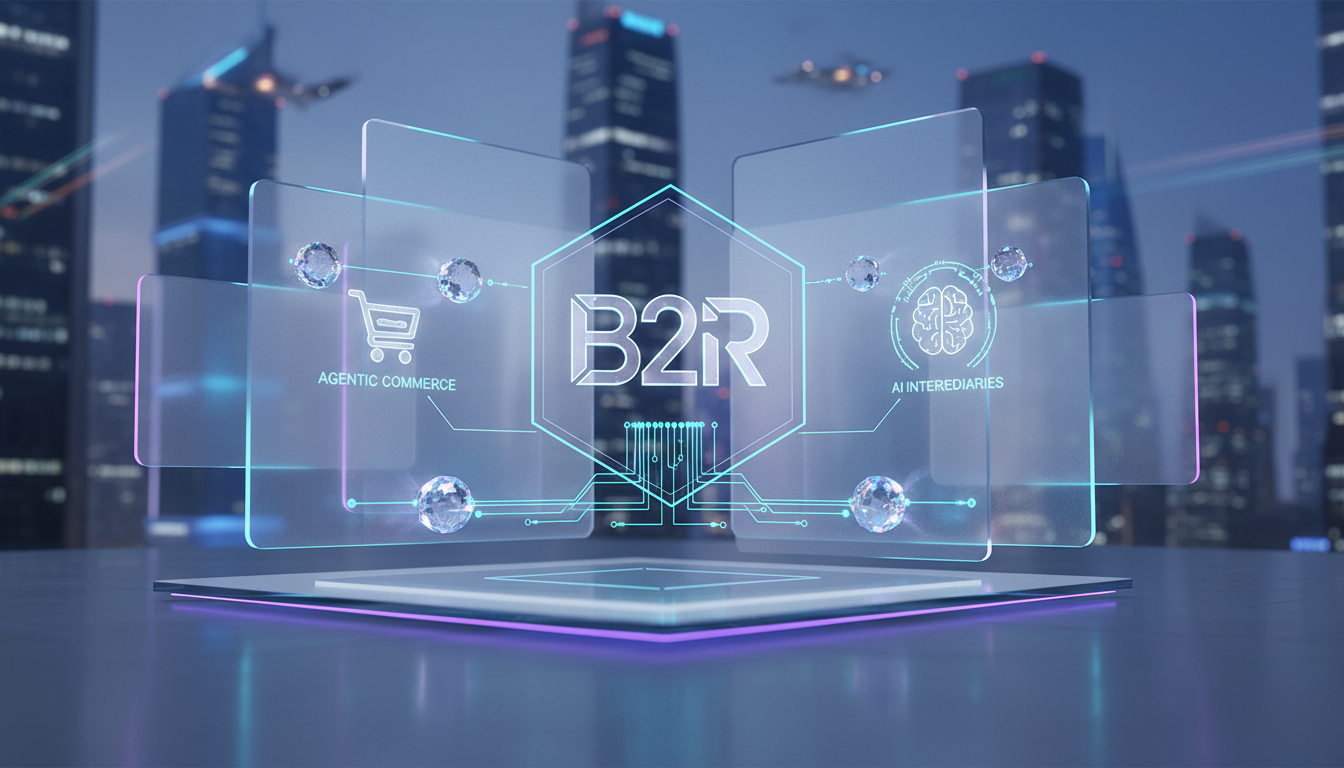
The B2R Revolution: Mastering Agentic Commerce and AI Intermediaries for the 2026 Market
As we navigate the economic landscape of late 2025 and enter 2026, a fundamental shift has occurred in the definition of the “customer.” For decades, commerce was dichotomized into Business-to-Consumer (B2C) and Business-to-Business (B2B). Today, we are witnessing the maturation of a third, dominant pillar: Business-to-Robot (B2R). This transition is not merely a technological upgrade; it is a total restructuring of the sales funnel where the primary decision-maker is no longer a human, but an autonomous AI agent acting as an intermediary.
In the coming years of 2026, the brands that thrive will not be those with the flashiest user interfaces or the most emotional ad copy, but those that have successfully optimized their digital presence for Large Action Models (LAMs) and personal AI concierges. This guide outlines the architecture of this new reality and provides the strategic framework necessary to survive the age of Agentic Commerce.
The Architecture of Agentic Commerce: Understanding the B2R Ecosystem
To dominate the 2026 landscape, one must first understand the mechanics of the “Machine Customer.” Unlike the chatbots of 2023, which were reactive text generators, the AI agents of 2026 are proactive, goal-oriented, and capable of executing complex transactions without human oversight. This is the era of “Zero-Click Commerce,” where the transaction occurs in the background, orchestrated by digital assistants that curate, negotiate, and purchase on behalf of their human principals.
From B2C to B2R: The Shift to Algorithmic Procurement
The transition from B2C to B2R is characterized by the “Death of the Interface.” In a traditional B2C model, the goal was to drive human traffic to a website, optimize dwell time, and encourage clicks. In the B2R model, the goal is API accessibility and semantic clarity. The AI agent does not “view” a website; it parses data. If your product information is locked behind heavy JavaScript, unindexed databases, or unstructured HTML, you are effectively invisible to the machine buyer.
By 2026, it is estimated that 25% of all routine consumer purchases—groceries, household staples, and subscription services—will be automated. The implications are profound: brand loyalty is no longer about emotional connection but about data reliability, availability, and logistical performance. The AI does not care about your logo’s color palette; it cares about your schema markup, your real-time inventory accuracy, and your verified sustainability credentials.
The New Buyer Persona: Profiling the AI Intermediary
Marketing teams must now develop personas for software rather than humans. Understanding the logic gates and decision trees of these intermediaries is crucial for Generative Engine Optimization (GEO).
The Task-Oriented Executor
This class of AI agent is designed for efficiency. It is given a specific command: “Restock the pantry with the most cost-effective organic protein powder.” The Executor scans thousands of retailers in milliseconds, prioritizing price, delivery speed, and verified specifications. To appeal to the Executor, businesses must compete on quantifiable metrics and ensure their pricing data is structurally structured for instant comparison.
The Analytical Curator
The Curator is deployed for high-consideration purchases. A user might ask, “Find me a vacation package for March 2026 that aligns with my preference for eco-tourism and stays under $5000.” The Curator synthesizes reviews, reads terms of service, cross-references carbon offset data, and presents the human with exactly three viable options. Here, “ranking” is not about keyword density; it is about “answer engine” optimization—being the most semantically relevant and factually robust solution in the AI’s dataset.
Generative Engine Optimization (GEO) vs. Traditional SEO
SEO as we knew it in 2024 is obsolete. The search engine results page (SERP) containing ten blue links has been replaced by the AI Snapshot and direct answers. GEO focuses on optimizing content for Large Language Models (LLMs) and LAMs. This requires a shift from keywords to entities. The focus is no longer on “best running shoes 2026” but on establishing your product as a recognized entity within the Knowledge Graph, associated with attributes like durability, biomechanics, and material science. If the AI cannot verify your claims through cross-referenced authoritative data sources, you will be excluded from the consideration set.
Strategic Implementation: Future-Proofing Your Brand for the Robot Economy
Recognizing the shift is step one; re-engineering your digital infrastructure is step two. The strategies outlined below are mandatory for any enterprise wishing to remain solvent in the algorithmic marketplace of 2026.
Structuring Data for Non-Human Consumption
The most critical asset in the B2R revolution is structured data. Your website serves two masters now, and the robot is the more demanding one. We are moving beyond basic Schema.org implementation into deep semantic tagging.
The Semantic Web and Knowledge Graph Integration
In 2026, ambiguity is the enemy of revenue. You must utilize JSON-LD to its fullest extent to explicitly define every attribute of your offering. Ambiguous product descriptions will lead to hallucination risks, causing AI agents to blacklist your domain to avoid error. Brands must actively manage their entries in public knowledge bases (like Wikidata) and industry-specific ontologies to ensure the AI has a “ground truth” regarding their products.
API-First Inventory Management
Static webpages are insufficient for Agentic Commerce. AI intermediaries demand real-time data. If an agent attempts to purchase a product that is listed as “in stock” on the frontend but is out of stock in the warehouse, the transaction fails, and the agent’s reinforcement learning algorithm penalizes your vendor score. By 2026, leading retailers will offer “Commerce APIs” specifically designed for bot access, bypassing the storefront entirely to reduce latency and server load while increasing conversion accuracy.
Building Trust Protocols for Autonomous Agents
Trust in the B2R era is cryptographic, not aesthetic. AI agents verify the legitimacy of a seller through digital signatures, blockchain-verified supply chain data, and SSL/TLS advancements.
Verifiable Credentials and Digital Identity
To prevent fraud, AI agents rely on Verifiable Credentials (VCs). Brands must adopt decentralized identity standards to prove they are who they say they are. This includes cryptographically signing content to prove provenance—a necessity in an era flooded with AI-generated counterfeit listings. If your business lacks a robust digital identity framework, high-security agents (banking AIs, medical AIs) will simply refuse to transact with you.
The Ethical Landscape of Automated Decision Making
As we hand over purchasing power to algorithms, ethical alignment becomes a competitive advantage. AI agents in 2026 are increasingly programmed with “value alignment” filters. A user can set their agent to “only buy from carbon-neutral companies” or “avoid supply chains with labor violations.” Consequently, your ESG (Environmental, Social, and Governance) reports are no longer just PDF downloads for investors; they are data inputs that directly influence the purchasing algorithm. Greenwashing will be detected by analytical AIs capable of auditing supply chain data in seconds; genuine transparency will be the only viable strategy.
Actionable Roadmap for 2026 and Beyond
To succeed in this brave new world, organizations must take immediate action:
1. Audit for Machine Readability: Run a comprehensive audit of your digital footprint. Can an LLM accurately summarize your value proposition without hallucinating? If not, rewrite your content for semantic clarity.
2. Develop a B2R API: Create a dedicated endpoint for AI agents that provides lightweight, JSON-formatted product data, pricing, and real-time availability.
3. Optimize for Voice and Conversational Intent: As smart glasses and ambient computing dominate 2026 hardware, queries are becoming conversational. Ensure your content answers complex questions directly.
4. Monitor Agentic Analytics: Move beyond Google Analytics. Invest in tools that track non-human traffic patterns and analyze how AI intermediaries are scraping and interpreting your data.
The B2R revolution is not a distant future; it is the operating reality of the 2026 economy. By treating the AI intermediary as your most important customer, you position your brand at the forefront of the next great leap in commerce. The brands that resist will fight for the scraps of human attention; those that adapt will enjoy the efficiency and scale of the automated market.