
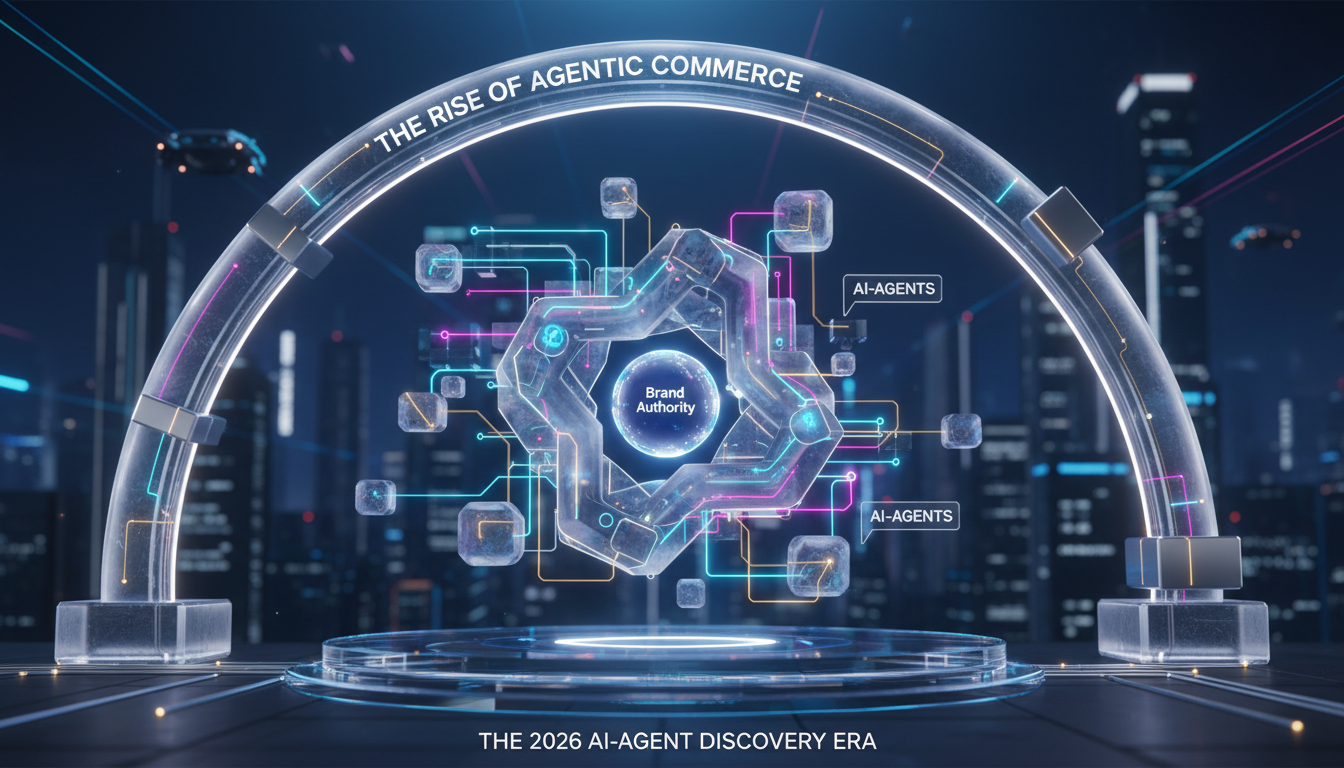
The Rise of Agentic Commerce: Orchestrating Brand Authority for the 2026 AI-Agent Discovery Era
The traditional search engine results page (SERP) as we knew it in the early 2020s has been relegated to the archives of digital history. As we navigate the commercial landscape of late 2025 and approach 2026, the paradigm has shifted entirely from human discovery to Agentic Commerce. We no longer optimize for human eyeballs scrolling through ten blue links; we optimize for autonomous AI agents tasked with executing complex decisions on behalf of their human principals.
In this new era, the consumer is not the browser—the consumer is the prompter, and the researcher is a neural network. When a user tells their personal AI assistant, "Book a sustainable vacation to Kyoto for under $5,000" or "Restock my pantry with high-protein, plant-based snacks," the agent does not browse. It executes. It parses billions of data points, cross-references verified reviews, analyzes supply chain transparency, and executes the transaction via API, often without the human ever visiting a website.
This guide serves as the definitive blueprint for future-proofing your brand authority. To survive the 2026 transition, businesses must stop treating AI as a content generator and start treating it as the primary customer.
The Architecture of Machine Trust: Structuring Data for Autonomous Buyers
For an AI agent to purchase your product, it must first understand it. In 2023, Search Engine Optimization (SEO) was about convincing an algorithm that your content was relevant. In 2026, Agentic Optimization (AO) is about providing "semantic certainty" to a machine that demands logic, facts, and structured verification. Ambiguity is the enemy of agentic conversion.
From Keywords to Semantic Knowledge Graphs
Keywords are dead; entities are king. Agents do not match strings of text; they map relationships between entities. If your brand relies on vague marketing fluff, you are invisible to the inference engines driving 2026 commerce. You must build a proprietary Knowledge Graph that feeds the Large Language Models (LLMs) accessing the web.
Implementing JSON-LD+ and Federated Schema
Standard Schema markup was the baseline of 2024. Today, brands must implement JSON-LD+ (an extended vocabulary developed for AI interoperability). This involves nesting data so deeply that an agent can determine not just price and availability, but the carbon footprint of the shipping method, the ethical sourcing certification of the raw materials, and the compatibility of the item with the user’s existing ecosystem—all without scraping HTML.
For example, a fashion retailer in 2026 cannot simply tag a shirt as "cotton." The structured data must explicitly link the specific cotton entity to its origin farm, its Global Organic Textile Standard (GOTS) certification ID, and its localized sizing metrics mapped against the user’s stored digital twin measurements. If this data is not machine-readable in a structured format, the agent will bypass your store for a competitor whose data reduces the risk of a return.
The Role of Vector Database Visibility
Modern search is vector-based. LLMs convert your product data into high-dimensional vectors (numerical representations of meaning). To capture market share in 2026, your content must reside in the same "neighborhood" within the vector space as the user’s intent. This requires a strategy of Vector Search Optimization (VSO).
VSO involves auditing how your brand descriptions are tokenized and ensuring your content aligns with the conceptual clusters agents associate with high quality. You are no longer writing for a reading level of 8th grade; you are writing to minimize the "hallucination gap" for an AI. Precise, dense, and fact-heavy descriptions rank higher in vector retrieval than emotive, adjective-heavy copy.
The Verification Protocol: How Agents Validate Authenticity
In an internet flooded with AI-generated sludge, trust is the most expensive currency. AI agents acting as fiduciaries for their users operate on a "Zero Trust" model. They do not believe your marketing copy; they verify your claims through decentralized consensus and cryptographic proof.
Blockchain-Backed Supply Chain Transparency
By 2026, "Digital Product Passports" (DPPs) have become mandatory in the EU and de facto standard globally. Agents prioritize products where claims are cryptographically verifiable. If your structured data claims a product is "fair trade," the agent expects a link to a blockchain ledger confirming that payment was released to the producer.
Brands must expose these verification keys via API. If an agent is tasked with finding "guilt-free coffee," it will query the ledger. If your supply chain is opaque, your "authority score" drops, and you are excluded from the consideration set. Authenticity is no longer a brand sentiment; it is a verifiable data point.
Social Proof in the Era of Deepfakes
Review bombing and fake testimonials destroyed the utility of traditional 5-star systems by 2024. In the Agentic Era, agents rely on Cryptographic Attribution for reviews. Agents prioritize feedback from verified wallets or verified human IDs (World ID or similar protocols).
To build authority, brands must aggregate "Proof of Purchase" reviews. An agent weighs one review from a verified blockchain transaction significantly higher than 10,000 anonymous 5-star ratings. Your strategy must shift from gathering volume to ensuring verification. The prompt for 2026 marketing is not "Get more reviews," but "Get verifiable attestations."
Strategic Authority: Influencing the "Black Box" of Agent Decision-Making
Once your technical architecture is sound, you must address the strategic layer. How do you influence the "preference weights" of a neural network? Unlike the Google algorithm of old, which was a static set of rules, 2026 AI models are fluid and probabilistic. Influencing them requires a fundamentally different approach to brand authority.
Optimizing for "Zero-Click" Conversions
The concept of a "session" is disappearing for transactional commerce. The user does not visit your site; the agent does. Therefore, your site must function primarily as an API endpoint and secondarily as a visual interface. This is the reality of Headless Authority.
Your "About Us" page is no longer for humans; it is training data. It must clearly articulate your brand’s expertise, authoritativeness, and trustworthiness (E-E-A-T) in a format that LLMs digest easily. This means creating "Corpus Pages"—dense, text-heavy, highly cited summary pages designed specifically to be ingested by crawlers like GPTBot or ClaudeBot. These pages serve as the "ground truth" regarding your brand, preventing the AI from hallucinating details about your return policy or warranty.
Brand Voice and LLM Training Data
To be recommended by an agent, your brand must appear frequently in the context of "expert consensus" within the model’s training data (or its retrieval-augmented generation sources). This requires a shift in Public Relations strategy.
Content Density vs. Fluff
In the past, long-form content with repeated keywords worked. In 2026, AI models penalize low-information density. "Fluff" increases token costs for agents and lowers the probability of retrieval. High-authority content is now characterized by Information Gain—the provision of new, unique data points not found elsewhere.
Stop publishing generic "Top 10 Tips" articles. Instead, publish original research, proprietary data sets, and contrarian analysis. Agents are programmed to seek the primary source. If you are the source of the statistic, you win the citation. If you are merely quoting it, you are filtered out.
Becoming the "Source of Truth"
You must actively manage your entity’s presence in public knowledge bases (Wikidata, Crunchbase, and industry-specific ontologies). Agents often cross-reference commercial claims against these neutral databases. If your official website claims you were founded in 1990, but Wikidata says 1995, the agent detects a "truth conflict" and lowers your trust score.
Strategic authority in 2026 involves Knowledge Graph Injection. This means actively contributing to open data standards and ensuring your brand’s definitions are the standard by which the industry is measured. When an agent asks, "What defines a high-quality widget?", your brand’s whitepaper should be the definition it retrieves.
The Privacy-First Personalization Paradox
As we move through 2025, privacy laws have tightened, effectively killing third-party cookies. However, agents operate on Zero-Party Data—data explicitly given to the agent by the user. The agent knows everything about the user, but it shields that identity from the brand until the moment of purchase.
To win here, you must optimize for Intent Matching rather than Demographic Targeting. You cannot target "Females, 25-34." You must target the intent vector of "Someone looking for non-toxic baby products with 2-day delivery reliability." Your content must signal that you can fulfill that specific intent. The agent negotiates the personalization. Your job is to offer modular value propositions that the agent can mix and match to fit its user’s profile.
Measuring Success: Beyond Traffic to "Agent Mentions"
The metrics of 2026 are radically different. "Time on Page" and "Bounce Rate" are irrelevant when an AI retrieves your data in milliseconds. The new KPIs are:
- Share of Model (SoM): How often is your brand mentioned when a generic product category is queried in an LLM?
- Retrieval Rate: How frequently is your API or structured data pinged by shopping agents?
- Verification Success: The percentage of times your cryptographic proofs (reviews, supply chain) pass agent validation checks.
Conclusion: The Agentic Pivot
The transition to Agentic Commerce is not merely a technical upgrade; it is a philosophical shift in how we define a "customer." By 2026, the brands that cling to visual persuasion and psychological triggers designed for human biases will find themselves shouting into the void. The brands that succeed will be those that build the most robust, transparent, and machine-readable data structures.
You are no longer building a storefront for eyes; you are building a database for intelligence. Structure your authority now, or become invisible to the machines that will make the buying decisions of the future.