
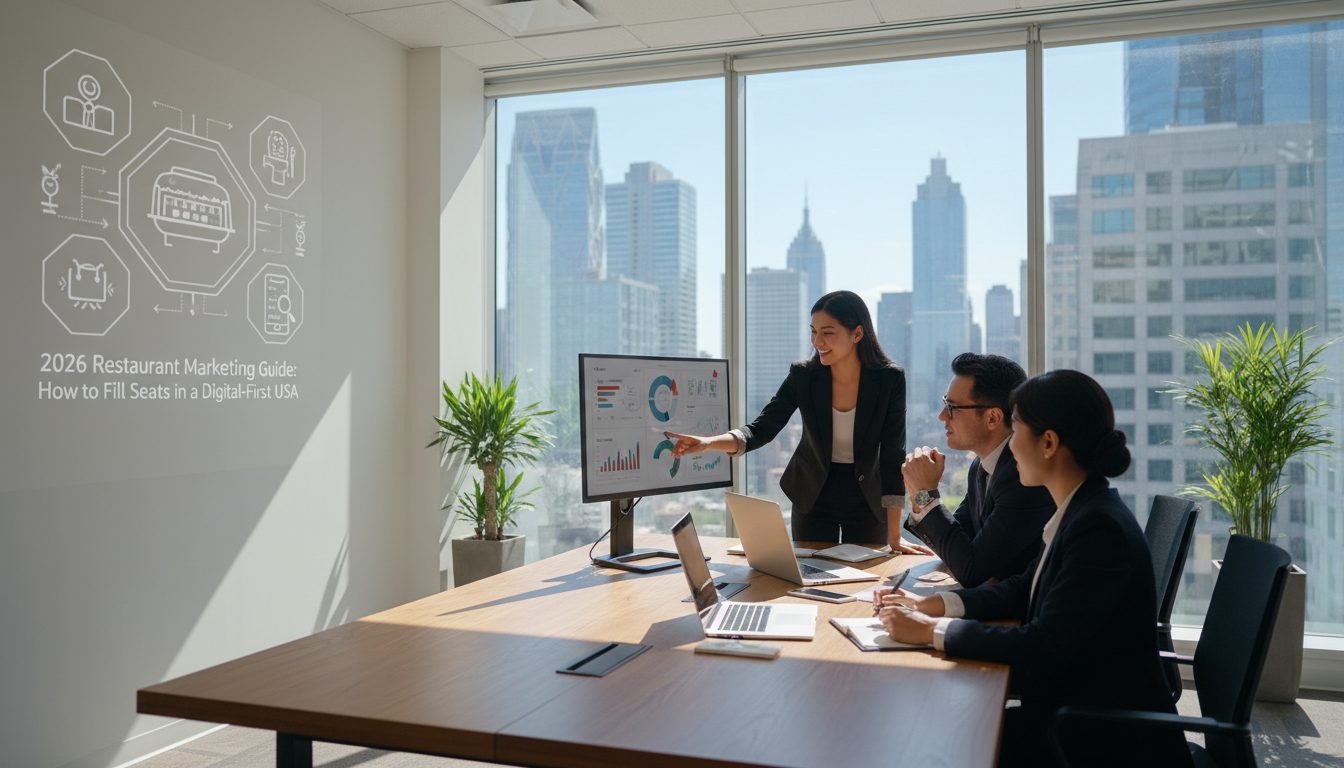
The 2026 Essential Playbook for Digital Marketing for Restaurants in USA: Attracting More Diners in the Digital Age
Let’s be honest with each other. The restaurant industry has never been for the faint of heart, but the landscape we face in 2026 is unrecognizable compared to just a few years ago. If you are operating a restaurant in the United States today, you already know that great food and decent service are merely the price of admission. They are not differentiators. They are the baseline.
The real battleground is digital. But I’m not talking about having a Facebook page that gets updated once a month or a website that looks like a PDF from 2018. I am talking about a sophisticated, data-led ecosystem that captures intent, converts hunger into reservations, and turns casual diners into evangelists. The American diner in 2026 decides where to eat based on predictive algorithms, voice search, and hyper-local signals. If your digital footprint isn’t optimized for these behaviors, you are invisible.
At California Web Mark Home, we have analyzed the data across thousands of touchpoints. The winners in the hospitality sector are no longer just culinary artists; they are data architects. This guide is your playbook. We are going to strip away the vanity metrics and focus on the revenue-generating activities that actually fill tables this year.
Pillar 1: The Infrastructure of Visibility and Trust
Before we discuss viral videos or influencer campaigns, we must address your foundation. In 2026, your digital infrastructure determines whether you even get the chance to serve a customer. The journey of the modern diner begins long before they smell the food. It begins with a query, often spoken to a device or typed into a predictive search bar.
Dominate the Hyper-Local Search Grid
Local SEO has evolved. It is no longer enough to rank for generic terms like “Italian restaurant.” The algorithms powering Google and Apple Maps in 2026 are context-aware. They look for proximity, relevance, and real-time activity. When a potential customer in your city asks their AI assistant for a recommendation, that assistant is running a split-second auction in the background. It is weighing your reviews, your schema markup, and your current operational status.
You need to treat your Google Business Profile (and its 2026 equivalents) as your primary homepage. This is where the decision is made. If your menu isn’t machine-readable, if your hours aren’t dynamically updated, and if your photos aren’t geotagged properly, you are losing market share to the franchise down the street that has automated this process. This requires rigorous SEO & Organic Search Engineering. You must structure your data so that when a machine crawls your entity, it understands exactly what you serve, what the vibe is, and why you are the best option within a 2-mile radius.
One specific tactic that is crushing it right now is the utilization of “Vibe Check” keywords. Diners are searching for specific atmospheres—”quiet romantic dinner,” “high energy sports bar,” “kid-friendly patio with shade.” Your content must explicitly signal these attributes to the search engines.
The Non-Negotiable Speed of Experience
Let’s talk about your actual website. In 2026, a website is not a brochure; it is a transactional utility. The patience of the American consumer is effectively zero. If your mobile site takes more than two seconds to load the menu, you have lost the customer. They have already bounced back to the search results and clicked on your competitor.
We consistently see restaurateurs invest heavily in interior design but neglect their digital storefront. This is a fatal error. Your website needs to be a Progressive Web App (PWA) that feels like a native application. It must allow for seamless, one-tap reservations and ordering. This is where professional Web Development & UX becomes an investment in revenue, not an expense. You need friction-free interfaces. If a user has to pinch and zoom to read a PDF menu on their phone, you are failing them. The menu should be HTML-based, interactive, and integrated with your POS system for real-time 86ing of items.
Reputation as Currency
Reviews are the single most critical asset you own. In 2026, AI summaries of reviews are the first thing a consumer sees. They don’t read the last ten reviews; they read a generated summary that says, “Diners love the pasta but complain about slow service on Fridays.” That summary is your brand reputation.
You must have a strategy for generating positive sentiment. This doesn’t mean buying fake reviews—platforms are too smart for that now. It means automated follow-ups via SMS or email post-dining, prompting satisfied guests to share their experiences. It means responding to every single review with a human tone, addressing grievances, and showcasing your commitment to hospitality.
Pillar 2: The Engine of Engagement and Retention
Once you have built the infrastructure, you need to fuel the engine. This is where marketing shifts from passive availability to active acquisition. In the US market, attention is the most expensive commodity. To capture it, you need to be aggressive, creative, and precise.
Visual Storytelling and Short-Form Video
Static images of food are fine, but they are 2020 tactics. The 2026 standard is immersive video. Platforms like TikTok, Instagram Reels, and YouTube Shorts (and their successors) are the primary discovery engines for Gen Z and Millennials, who now make up a massive portion of dining revenue. They don’t want to see a staged photo of a burger. They want to see the cheese pull, the steam rising, the chef plating the dish, the bartender shaking the cocktail.
This requires a shift in mindset. You are not just a restaurant; you are a content studio. You need to be producing high-velocity content that captures the *experience* of dining with you. This is where Video Production & Content Engineering comes into play. It’s not about high-production commercials; it’s about authentic, raw, and appetizing clips that stop the scroll.
Additionally, you must leverage User Generated Content (UGC). Incentivize your diners to post. create “Instagrammable” (or the 2026 equivalent) moments in your physical space—lighting, neon signs, unique plating—that beg to be shared. When a customer shares their meal, that is a peer-to-peer endorsement that is infinitely more valuable than any ad you could buy.
Precision Paid Media
Organic reach is great, but it is unpredictable. To guarantee covers on a Tuesday night, you need paid acquisition. However, the days of “boosting” a post and hoping for the best are over. You need surgical precision.
We are talking about geofencing and day-parting strategies. Imagine running ads that only appear to people within a 1-mile radius of your restaurant, and only between 11:00 AM and 1:00 PM, featuring your lunch special. Or targeting users who have visited your competitors in the last 30 days. This level of granularity is possible with advanced PPC, Google & Meta Ads management. You stop wasting money on people who live 20 miles away and start paying only for high-intent local traffic.
Retargeting is also essential. If someone visited your reservation page but didn’t book, they should see an ad for your restaurant on their social feed later that day, perhaps offering a free appetizer to close the deal. This is basic e-commerce strategy applied to hospitality, and it works remarkably well.
The Community and Social Proof
Social media is not a megaphone; it is a telephone. You need to talk *with* your community, not *at* them. Your social channels should highlight your staff, your suppliers, and your regulars. Humanize the brand. People dine at places they feel connected to.
Effective Social Media Management involves active community management. It means replying to DMs within the hour. It means reposting customer stories. It means collaborating with local micro-influencers—not the ones with 1 million followers who charge $5,000, but the local foodies with 10,000 followers who live in your neighborhood and have high engagement rates.
Owning the Customer Data
Here is the hard truth: If you rely solely on DoorDash, UberEats, or OpenTable, you do not own your customers. Those platforms own the data. They can shut you off or raise fees at any moment. Your goal in 2026 must be to convert third-party users into direct customers.
This is done through retention marketing. You need to build a database of emails and phone numbers. How? By offering value. “Join our VIP club for a free dessert.” “Scan this QR code for secret menu items.” Once you have that data, you can bypass the algorithms.
With sophisticated Email Marketing & Automation, you can trigger personalized messages based on behavior. Did a customer not visit for 60 days? Send them a “We miss you” offer. Is it their birthday? Automated gift. These automated flows print money in the background while you focus on running the kitchen.
The Role of Voice and AI Integration
We cannot ignore the AI elephant in the room. In 2026, many reservations are booked by AI agents acting on behalf of humans. Your digital presence must be optimized for this. This means your booking platform must be compatible with major AI assistants. It also means your structured data (which we discussed in the SEO section) must provide availability data in real-time.
When a user says, “Book a table for four at an Italian place near me at 7 PM,” the AI is looking for open slots. If your inventory isn’t digitized and accessible via API, you aren’t even in the running. This is the technical bleeding edge where the best restaurants are pulling ahead.
Analyzing the ROI
Finally, we need to talk about measurement. Marketing without attribution is just gambling. As a business owner, you need to know your Customer Acquisition Cost (CAC) and your Lifetime Value (LTV). You need to know that for every $1 you spend on Google Ads, you are generating $5 in revenue.
This requires a unified dashboard that tracks reservations, online orders, and foot traffic attribution. If you aren’t tracking this, you are flying blind. You need to understand which channels are driving the high-ticket dinners and which are driving the low-margin lunch crowd, and adjust your budget accordingly.
Conclusion: The Time to Pivot is Now
The restaurant industry in the USA has fundamentally changed. The nostalgic idea that “good food speaks for itself” is a fast track to closure in 2026. Good food keeps them coming back, but digital marketing gets them in the door.
You have two choices. You can continue to rely on hope and foot traffic, or you can build a predictable, scalable revenue engine using the tools available today. The digital ecosystem is complex, but it is also the greatest opportunity for growth we have ever seen in this industry.
If you are ready to stop guessing and start growing, you don’t have to do it alone. We specialize in building these exact systems for high-growth hospitality brands. Contact Us today, and let’s build a strategy that fills your tables every single night. The future of dining is digital—make sure you are the one serving the meal.