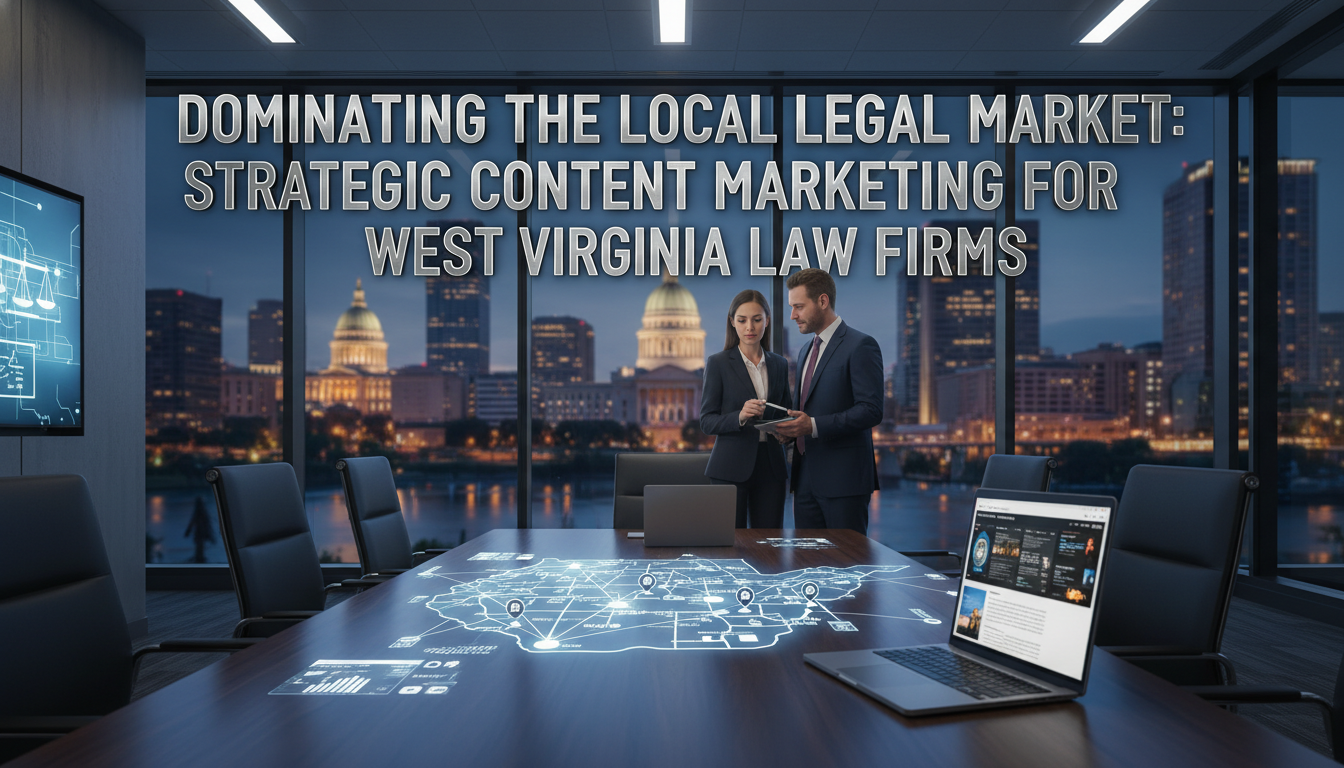
Dominating the Local Legal Market: Strategic Content Marketing for West Virginia Law Firms
In the rugged, community-driven landscape of West Virginia, trust isn’t bought through flashy billboards—it is earned through demonstrated expertise, profound empathy, and authoritative presence. For modern law firms in the Mountain State, strategic content marketing has evolved from an optional digital tactic into the absolute cornerstone of client acquisition and market domination.
The Shifting Paradigm of Legal Client Acquisition
The days of relying solely on word-of-mouth referrals and yellow-page dominance are long gone. Today, when a resident in Charleston, Morgantown, or Huntington faces a critical legal issue—be it a complex personal injury claim, a sensitive family law matter, or a critical business dispute—their first instinct is to turn to search engines. They are looking for answers, reassurance, and, ultimately, an attorney who demonstrates an unshakeable grasp of West Virginia law.
This is where a robust content marketing strategy becomes your firm’s most tireless advocate. By answering the exact questions your prospective clients are asking, you intercept them at their moment of highest intent. Rather than selling to them, you are educating them. This approach builds a foundation of trust before they ever walk through your doors or schedule a consultation. To execute this effectively at scale, firms must leverage comprehensive Digital Marketing Services tailored specifically for the legal sector’s stringent compliance and ethical standards.
Engineering Search Dominance: The SEO Imperative
Creating brilliant legal content is only half the battle; ensuring it reaches your target audience in West Virginia is where the real competition lies. Legal keywords are among the most expensive and highly contested in the digital marketing ecosystem. A strategic approach to SEO & Organic Search Engineering is required to outrank aggressive national directories and local competitors.
Hyper-Local Targeting
West Virginia’s unique geography requires hyper-local targeting. Content must be optimized not just for state-wide queries, but for specific county and city-level searches (e.g., ‘Kanawha County auto accident lawyer’ vs. ‘WV injury attorney’).
EEAT Optimization
Google’s algorithm prioritizes Experience, Expertise, Authoritativeness, and Trustworthiness (EEAT)—especially for Your Money or Your Life (YMYL) topics like law. Attorney bios, case studies, and accurate legal analysis are non-negotiable.
Content Velocity and Creative Strategy
To maintain top-of-mind awareness and continually feed the search engine algorithms, your law firm must maintain a consistent publishing schedule without sacrificing quality. This requires a sophisticated Creative Strategy & Content Velocity model. A static website with ten pages detailing your practice areas is essentially a digital brochure. A dynamic, market-dominating website is a living library of legal insight.
Consider developing a content matrix that includes long-form pillar pages (e.g., ‘The Comprehensive Guide to West Virginia Workers’ Compensation’), timely blog posts reacting to recent state supreme court rulings, engaging video FAQs addressing common client anxieties, and downloadable checklists for clients preparing for depositions. This multi-format approach ensures that regardless of how a prospective client prefers to consume information, your firm is there to provide it.
Corporate Law and High-Stakes B2B Growth
For West Virginia law firms specializing in corporate law, energy sector regulations, or employment defense, the target audience is not the general public, but C-suite executives, in-house counsel, and business owners. Traditional mass-market content strategies often fail in this arena. Instead, these firms must adopt highly targeted strategies.
Implementing Account-Based Marketing (ABM) & B2B Growth tactics allows corporate law firms to treat high-value prospective clients (such as regional coal, gas, or manufacturing companies) as individual markets. Content in this sphere should include highly technical whitepapers, exclusive industry webinars, and direct-mail executive summaries of emerging regulatory threats. By positioning your partners as indispensable industry thought leaders, you bypass the traditional RFP process and secure lucrative, long-term retainers.
Expanding Horizons: Scaling Beyond the Local Market
While dominating the West Virginia market is the primary objective, ambitious firms often identify opportunities in neighboring jurisdictions like Ohio, Pennsylvania, or Kentucky. Whether it is mass torts, federal criminal defense, or multi-state corporate litigation, expanding your digital footprint requires careful planning.
Executing a Global Growth & Localization Strategy ensures that as you target new regions, your content is precisely calibrated to the specific jurisdictional nuances and local search behaviors of those areas. It is not enough to simply duplicate a West Virginia page and change the state name; search engines will penalize such lazy tactics, and local clients will instantly recognize the lack of authentic local knowledge.
Deep-Dive FAQ: Legal Content Marketing in West Virginia
1. Why is content marketing so crucial for West Virginia law firms?
In WV, communities are tight-knit. Content marketing allows firms to establish trust at scale by demonstrating expertise and empathy before a client ever makes a phone call, effectively bridging the gap between digital search and personal connection.
2. How long does it take to see results from an organic SEO strategy?
Legal SEO is highly competitive. Generally, a firm can expect to see initial movement within 3 to 6 months, but true market dominance and substantial lead generation usually require 9 to 12 months of sustained, high-quality content velocity.
3. What type of content performs best for personal injury lawyers in WV?
Hyper-local, scenario-specific content performs best. For example, ‘What to do after a coal truck accident on Route 119’ will convert much higher than a generic ‘auto accident lawyer’ page because it speaks to a very specific, localized pain point.
4. How do we ensure our content complies with WV State Bar advertising rules?
All content must avoid guaranteed outcomes, utilize appropriate disclaimers (e.g., ‘This is for informational purposes only and does not constitute legal advice’), and never misrepresent the firm’s experience. Partnering with a marketing agency experienced in legal compliance is highly recommended.
5. Can a boutique solo practitioner compete with massive state-wide firms?
Absolutely. Boutique firms can win by niching down. While a massive firm might dominate broad terms, a solo practitioner can monopolize highly specific, long-tail search queries and specific local geographic areas that larger firms overlook.
6. Should our firm invest in written blogs, video content, or podcasts?
An omnichannel approach is best. Written content drives organic SEO, while video content (like YouTube or social media snippets) drastically increases engagement and trust by letting prospects see and hear the attorney before hiring them.
7. What is the difference between Local SEO and General SEO for lawyers?
Local SEO focuses on the Google Map Pack and location-based queries (optimizing Google Business Profiles, acquiring local citations, and geo-targeted keywords). General SEO focuses on ranking the firm’s website for broader informational and transactional legal queries.
8. How can corporate and business law firms utilize Account-Based Marketing (ABM)?
Instead of waiting for businesses to search for them, corporate firms use ABM to identify specific target companies (e.g., energy firms in the Marcellus Shale region) and deliver highly personalized content directly to their decision-makers, bypassing standard search entirely.
9. Do client reviews impact our content marketing efforts?
Immensely. Google uses reviews as a primary ranking signal for Local SEO. Furthermore, strategically embedding positive client testimonials within your content pages provides immediate social proof that increases conversion rates.
10. Is it better to write content in-house or hire a legal marketing agency?
While attorneys have the legal expertise, they rarely have the time or SEO knowledge to optimize content for search engines consistently. The most successful model is usually a hybrid: attorneys provide the raw insights and legal review, while a specialized agency handles the writing, SEO engineering, and distribution.
Ready to Command the Mountain State’s Legal Market?
Do not let your competitors define the legal narrative in West Virginia. Take control of your firm’s growth trajectory by deploying elite, data-driven content marketing strategies designed specifically for the modern legal landscape.




2 Comments
The mobile experience is top-notch. It feels just like a native app and runs perfectly on my phone without any glitches. Download or visit b9gameapp for the best action.
The bonuses they offer for new players are legit and really give you a head start. I’m having a blast exploring the slots at vn5mm88